
| Tensile Strength | Tensile Modulus | Elongation at Break | Density | Moisture Regain | LOI | Heat Resistance* | ||||||
|---|---|---|---|---|---|---|---|---|---|---|---|---|
| Units | cN/dtex | g/d | GPa | cN/dtex | g/d | GPa | % | g/cm3 | % | °C | °F | |
| ZYLON-AS (regular) | 37 | 42 | 5.8 | 1150 | 1300 | 180 | 3.5 | 1.54 | 2 | 68 | 650 | 1202 |
| ZYLON-HM (high modulus) | 37 | 42 | 5.8 | 1720 | 2000 | 270 | 2.5 | 1.56 | 0.6 | 68 | 650 | 1202 |
| p-Aramid | 19 | 22 | 2.8 | 750 | 850 | 109 | 2.4 | 1.45 | 4.5 | 29 | 550 | 1022 |
| m-Aramid | 4.7 | 5.3 | 0.65 | 124 | 140 | 17 | 22 | 1.38 | 4.5 | 29 | 400 | 752 |
| Steel Fiber | 3.5 | 4 | 2.8 | 260 | 290 | 200 | 1.4 | 7.8 | 0 | — | — | — |
| Carbon Fiber | 20 | 23 | 3.5 | 1310 | 1480 | 230 | 1.5 | 1.76 | — | — | — | — |
| PBI | 2.7 | 3.1 | 0.4 | 40 | 45 | 5.6 | 30 | 1.4 | 15 | 41 | 550 | 1022 |
| Polyester | 8 | 9 | 1.1 | 110 | 125 | 15 | 25 | 1.38 | 0.4 | 17 | 260 | 500 |
Zylon® / PBO
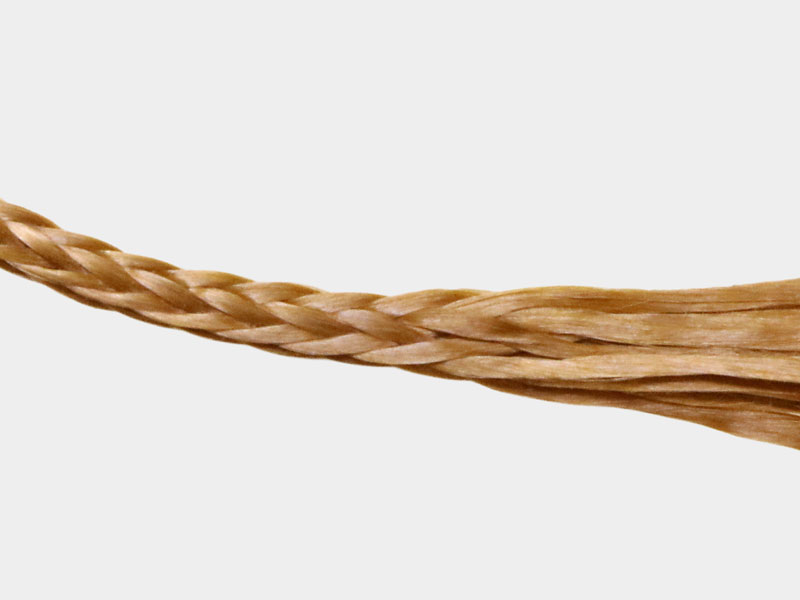
PBO, BraidedZylon® Polybenzyloate (PBO) is a rigid-rod isotropic crystal polymer that is spun by a dry-jet wet spinning process.
Zylon / PBO was first developed in the 1980’s and studies suggest the mechanical strength to be more than two times stronger than any other commercialized synthetic fiber. It is also the first organic fiber whose cross-sectional strength outperforms both steel and carbon fiber. Its high creep resistance and tensile strength potentially makes Zylon / PBO as one of the strongest synthetic fibers in the overall fibers market.
The strength of ZYLON® / PBO decreases in the condition of high temperature and high humidity. To maintain its mechanical properties, the fiber should be stored free from exposure to light, high temperature and humidity.
The manufacturing costs involved with the production of Zylon / PBO are also very high, therefore PBO fibers are used mainly in demanding applications such as strength members in defense-application products.
Features / Benefits
- Excellent strength & modulus properties
- Good flame resistance
- Excellent thermal stability
- Excellent resistance to creep
- Good chemical resistance
Disadvantages
- Very poor UV resistance
- Poor compressive strength
- Strength loss in exposure to strong acids
Applications
- Strength member
- Defense and military applications